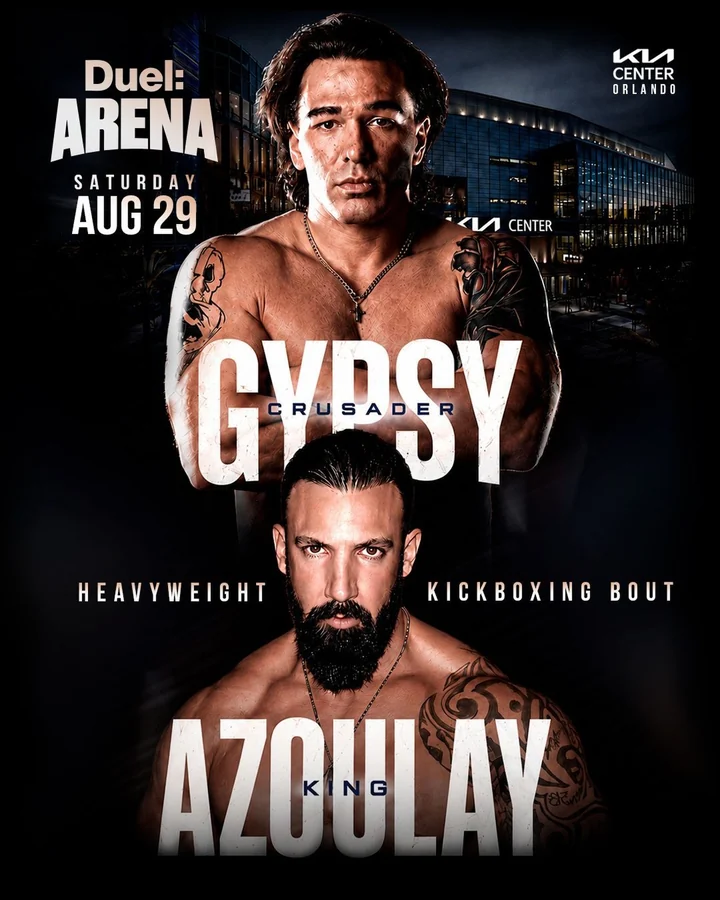
Gypsy Crusader vs Ben "King" Azoulay — result & full fight
The most argued-over fight on the Duel: Arena 1 card was not the main event — it was this one, and it went the distance. Gypsy Crusader, real name Paul Miller, beat Ben “King” Azoulay by split decision after three rounds of heavyweight kickboxing: 30-27 and 30-27 for Miller, 29-28 the other way. Below are the scorecards, the official full fight, what the 32.8 lb weigh-in gap actually meant, and why a booking between two internet figures drew as much criticism as attention. For the headline act, the venue and the rest of the card, go to our Duel: Arena 1 hub.
✅ FinalGypsy Crusader beat Ben Azoulay by split decision after 3 rounds.
📌 Card is doneDuel: Arena 1 is over. The promotion has said from the start that it intends to run more — when Arena 2 is announced, we will cover it here.
⚖️ Weigh-in · Fri 28 AugBoth made weight, but not the same weight. Gypsy Crusader 218.0 lb (98.9 kg) · King Azoulay 185.2 lb (84.0 kg) — a gap of 32.8 lb (14.9 kg).
Sat, Aug 29, 2026Doors 6:00 · first fight 7:00 PM ET
Weigh-in
218.0 vs 185.2a 32.8 lb gap
Venue
Kia CenterOrlando, Florida
Card position
Co-featureUnder Perry vs Jenkins
How the card was shown
Gypsy Crusader vs Azoulay was the co-feature on Duel: Arena 1, which ran on Saturday, 29 August at the Kia Center in Orlando — doors at 6:00 PM ET, first fight at 7:00 PM ET.
The card was pay-per-view at $29.99, ordered through DuelArena.tv and streamed worldwide via PlayLive. There was no broadcaster attached — no ESPN+, no DAZN, no linear TV deal. Fight week was free: the Thursday press conference and both Friday weigh-ins went out on the promotion's own YouTube and Facebook channels. The promotion has not said whether a replay will be sold or made free.
Built an online following through Omegle video streams performed in costume, in which he directed racist and antisemitic abuse at other users
Pleaded guilty to unlawful possession of a firearm and ammunition
Sentenced to 41 months in federal prison; he has said around six months of it were in solitary confinement
Fought Muay Thai and kickboxing in New Jersey from 2008, taking WKA regional and US national titles; lost twice by stoppage at a higher level in 2014 and 2015
Returned March 14, 2026 in Miami — won an exhibition by split decision on a Brand Risk Promotions card, then announced his retirement
Five months later he was back, and Azoulay was his first sanctioned professional bout
Social-media personality who competes on influencer boxing cards
Following built largely on TikTok
Best known outside fight circles for a widely mocked claim that he once fought thirty men at once
Had no recorded bout before this one — the fight with Ali Sobh that people search for is a callout that was never booked
Has not boxed on the professional circuit — his bouts have been on influencer cards
Result — August 29
Gypsy Crusader beat Ben Azoulay by split decision after 3 rounds.
Two judges had it 30-27 for Miller; the third scored it 29-28 for Azoulay. Azoulay was tougher than the build-up suggested — he was cut on the shin early and kept coming forward — but Miller's experience showed over three rounds.
Official full fight, published by Duel: Arena on YouTube. The player loads only when you press play.
The promotion also made a twenty-minute build-up film for this bout, published three days before the card. It is the second most-watched video on the channel — more watched than the fight itself.
Countdown documentary, published by Duel: Arena. Loads only on play.
Tale of the tape
Gypsy CrusaderPaul Nicholas Miller
vs
Ben Azoulayfights as "King Azoulay"
38 born 11 Aug 1988
Age
36 born 11 May 1990
6ft 1in 185 cm
Height
6ft 0in 183 cm · as listed — disputed, see below
72 in 183 cm · one source only
Reach
70 in 178 cm
218.0 lb 98.9 kg · was 197 lb at his last fight
Weighed in
185.2 lb 84.0 kg · 32.8 lb lighter
1–2 coming in — two TKO losses, 2014–15
Documented record
debut — no prior bout
Kickboxing & Muay Thai New Jersey · WKA regional & US national titles
Striking background
Influencer cards no formal record
Streaming, then boxing
Known for
TikTok
The asymmetry on the right is the story. Miller's numbers come from Tapology and his Muay Thai record profile — not from BoxRec, which files him under the same name as Paul James Miller, the Australian Olympian who holds a 15–2 professional boxing record. They are two different men, and that mix-up is why a record you may have seen elsewhere will not match this one. Azoulay's height, reach and date of birth come from his Muay Thai record profile, which also lists the 84 kg he actually weighed in at; his competitive record there is 0–1, this bout being the one. The height on it is a listing rather than a measurement, and the figures circulating on TikTok are mostly trolling — we show what is on record and say plainly where it came from.
How old are Gypsy Crusader and King Azoulay?
Gypsy Crusader is 38 — Paul Nicholas Miller was born on 11 August 1988, which made him 38 by three weeks on fight night. Ben “King” Azoulay is 36, born 11 May 1990. Two years apart on paper, and a long way apart in ring time: Miller started training in 2008 and had four documented bouts behind him, while this was Azoulay’s first.
Miller is old for a debutant on a professional card, and he said so himself afterwards when asked whether he would fight again — “it was a very long training camp.” His full record and current status are on his profile.
How tall are Gypsy Crusader and King Azoulay?
Gypsy Crusader is 6ft 1in (185 cm).Ben “King” Azoulay is listed at 6ft 0in (183 cm) with a 70-inch (178 cm) reach — but that second figure is a listing, not a measurement, and it is the most argued-over number attached to him.
Miller’s is the straightforward one: 6ft 1in appears on his fight-record profiles and matches the footage from both of his 2026 bouts. Be careful searching for it, though — BoxRec lists a different Paul Miller, an Australian Olympic boxer, at 181 cm. Azoulay’s 183 cm comes from his fight-record profile — the same profile that lists 84 kg, which is exactly what he weighed in at, so the weight on it is right. What nobody has published is an independently measured height for him.
The reason anyone asks is that height is Azoulay’s own subject. A large part of his following came from content built around it — height comparisons, jokes at his own expense, a running bit that he is secretly enormous. So “how tall is King Azoulay” was never really a fight question. It is what his audience had been asking long before he agreed to this bout; the fight just put it in front of a new crowd.
In the ring it was not the decisive number anyway. On the listed figures the two are within an inch of each other, and the real gap was on the scale — Gypsy Crusader weighed in 32.8 lb heavier. If the listed height is generous, the mismatch was bigger than the tape suggests. Azoulay still took it to a split decision.
What's actually confirmed
The promotion has announced the bout officially: Gypsy Crusader against King Azoulay, heavyweight kickboxing rules, on the Duel: Arena 1 card at the Kia Center in Orlando on Saturday, August 29. Like every fight on this card, it took place in a ring rather than a cage, and it went the full three rounds.
The pairing has been circulating for months — a meeting between the two was floated for a July date in Nashville before they were booked here. Duel's own announcement frames August 29 as the point where the pair "finally meet face to face and settle this once and for all", which was promoter language, not a result. The fight did happen — on 29 August, and Miller took the split decision.
Update, 13 August — the broadcast was settled. The card was pay-per-view at $29.99, ordered through DuelArena.tv and streamed worldwide via PlayLive. That confirms what Ryan Pownall, also on this card, had flagged two days earlier when he said PPV information was coming that week. Full detail in how to watch; the hub carries it for the rest of the card.
The weigh-in produced a 32.8 lb gap
Both men made weight on Friday, because there was no weight to make: this is a kickboxing bout with no announced limit. What the scale actually showed was the size of the mismatch. Gypsy Crusader came in at 218.0 lb. Ben Azoulay came in at 185.2 lb.
Thirty-two point eight pounds. In boxing that is the distance from super-middleweight to heavyweight — four divisions, with three more in between.
The promotion posted the numbers without comment. Its own audience supplied it: the most-liked reply under the announcement asks “almost 40lbs over him — how is that allowed?”, and it is a fair question. The answer is that this was a sanctioned bout — it is on the Florida Athletic Commission’s own results sheet, with both weights recorded. The twelve-pound cap that Representative Eskamani later cited in her complaint applies to boxing debuts; this was professional kickboxing, where a commission can approve an agreed catchweight, and Florida did.
What it means for the fight is simpler than the outrage suggests, and it cuts both ways. Mass helps whoever can use it — in kickboxing, where clinch work and low kicks matter, an extra 33 lb is a real advantage in every exchange. But carrying it for three rounds is a different problem, and he had never done it at that weight — his entire documented career was at 175 lb. The heavier man in a novelty bout is usually the favourite for two minutes and the underdog after five.
Why the booking is controversial
There's no way to cover this fight honestly without addressing it. Miller's fame did not come from combat sports — it came from streams in which he performed racist and antisemitic abuse, and that content is the reason most people know the name at all. He was subsequently sentenced to 41 months in federal prison on a firearms charge.
Worth stating plainly: promoting a fight is not the same as endorsing a fighter's views, and this page isn't an endorsement of Miller's. We're covering a bout that has been officially announced on a card we're writing about. Much of the social-media hype around this matchup — from Miller's own circle and the fan accounts amplifying him — has used explicitly antisemitic language. We haven't reproduced any of it here, and we won't.
The criticism from within the sport is straightforward: booking a figure whose entire public profile is built on racist content hands that profile a mainstream stage and an arena audience. The counter-argument the promotion is implicitly making is the one combat sports has always made about grudge matches — that unresolved animosity belongs in competition rather than online. You can decide for yourself which of those you find persuasive. We'd rather present the argument than pretend it doesn't exist.
Who wins — and the thing most previews miss
Almost every write-up of this bout treats it as two internet personalities swinging at each other. That misses something checkable: Miller competed in kickboxing and Muay Thai in New Jersey before any of the streaming happened. The fight on August 29 was contested under kickboxing rules — which meant the ruleset was not foreign to him, it was the one he came up in.
One of these men has a striking background you can look up. For the other, there isn't a record to check at all.
That's the honest asymmetry here. Miller has one win in an exhibition, a split decision in March that was disputed, plus a kickboxing past. Azoulay has appeared on influencer cards and has no formal record listed anywhere. Add the physical side — Miller at 6ft 1in and 218.0 lb on the scale, against a man listed an inch shorter who came in 32.8 lb lighter — and the paper case ran one way.
The counterweight is thinner than usual but real: Miller is 38, spent 41 months in prison and only returned to competition this year, and he announced his retirement immediately after that March win. A man who quit five months ago and is fighting anyway is not a safe bet on conditioning.
How you called it
The poll is closed — this is how it stood when the bell rang.
Gypsy Crusader90%
Ben Azoulay10%
863 votes cast before the fight
You called it. Gypsy Crusader won by split decision.
Duel: Arena is run by Duel — the casino and sportsbook are the same operator.
Short answer: no. There is no confirmed date, and no card. Azoulay vs Ali Sobh exists as a callout, not a booking — the two have gone back and forth on social media, Sobh has publicly asked where they should fight, and clips of the exchange circulate widely on TikTok. But no promotion has announced it, no venue has been named, and no date has been set. If you find a site listing a specific date for it, that date is not coming from anyone official.
This gets confused with Duel: Arena constantly, and it's easy to see why — same fighter, same few weeks, and the clips look like fight promos. So to separate them cleanly:
Confirmed: Azoulay vs Gypsy Crusader, heavyweight kickboxing, Saturday 29 August at the Kia Center in Orlando, on the Duel: Arena 1 card. The bout took place as scheduled; Duel was the operator behind it.
Not confirmed: Azoulay vs Ali Sobh. Callout only, no date, no promotion attached.
If you're looking at this card with a bet in mind rather than a ticket, our honest write-up of the Duel sportsbook covers what it does and doesn't do — including the offshore licensing you should read before depositing anywhere.
If the Sobh fight is ever booked, it will be a separate event — it is not on this card, and nothing about August 29 depends on it.
The retirement that lasted five months
The genuinely odd wrinkle here is that Miller had already quit. (His full record and current status are on the Gypsy Crusader profile.) After winning an exhibition by split decision in Miami on March 14, 2026 — on a Brand Risk Promotions card — he said he was finished, citing his age and other priorities. The decision itself was disputed.
Five months later he's booked at a 15,000-seat NBA arena. That turnaround tells you something about how this end of the sport works: a debut promotion needs eyeballs, a fighter with a notorious name delivers them, and retirements in influencer boxing have roughly the shelf life of a news cycle. Whether he's competitive under kickboxing rules is a completely separate question, and one nobody has much evidence for either way.
What to expect from the fight
Be realistic about the level — but not in the way most previews put it. The two men are not comparable here. Miller has a documented kickboxing and Muay Thai career: he started in 2008 in New Jersey, took WKA regional and US national titles as an amateur, and fought twice at a level above that, losing both by stoppage — Andrew Ball by TKO in the second in April 2014, Paul Banasiak by TKO in the third in August 2015. He then stopped for a decade. Azoulay came in with no prior bout at all. So on the ruleset that was actually contested, one of them had kicks and knees in his background and the other did not.
That combination — heavyweight, one man a decade out of the ring, the other with no bouts at all, and genuine bad blood — usually produces either an early finish or three rounds of exhausted swinging. It produced the second. Azoulay took it the distance and lost 30–27, 30–27, 29–28.
The lesson is worth keeping for the next one, because it applies to every card this promotion puts on: on debut fighters there is no form to price from, so the margins are wide and the numbers are closer to guesswork than to a read. If you back anyone on Duel: Arena 2 when it is announced, that is the position to take it from — small, and knowing the price is soft.
What a bet pays — work out any price
This bout is settled, so there is nothing left to price on it. Keep the calculator for the next card: when Arena 2 is announced and the lines go up, drop the number in and it does the arithmetic.
Profit if it lands
$5.00
Total returned
$15.00
Implied chance
66.7%
How to read it: −200 means you risk $200 to win $100, so it is the favourite. +150 means $100 wins you $150. The implied chance is what the price says about the fighter's odds of winning — but it includes the book's margin, which is why the two fighters' numbers add up to more than 100%. That gap is the house's cut, and on a fight where neither man has form to price, expect it to be a wide one.
Betting the next one — how it works
Worth saying plainly before you click anything: Duel is a crypto book that is no longer crypto-only. It has been widening its deposit options, and you can now fund an account with a card, Apple Pay, Google Pay or a bank transfer — no exchange account needed first. Withdrawals still go out in crypto, though, and that asymmetry is the thing to understand before you put money in rather than after. Here is the whole of it.
Open an account — no IDEmail and password, and that is the lot. Duel does not run identity checks at signup, so there is no document upload and nothing to get stuck in verification the week of a fight.
Fund it with a card, or with cryptoCard, Apple Pay, Google Pay, bank transfer and a stack of local methods all work — 30+ in total, and the list changes by country. What a card payment does is buy USDT, a token pegged to the dollar, and credit that to your balance, so check the “receive” figure before confirming. Already hold crypto? Send BTC, ETH, USDT, SOL, LTC, BCH, DOGE or TRX straight in, from about $1, with no platform fee on top of the network fee.
Find the card under the sportsbookDuel promotes these cards itself, so an Arena event sits in its own section rather than buried under MMA. Prices on the undercard go up later than the main event, so an empty market early in the week does not mean it stays empty. Arena 1 is finished and off the board; Arena 2 has not been announced, so there is nothing to price yet.
Know the way out before you need itIf the bet lands, the payout leaves in crypto — it is automatic, no manual review, roughly three minutes on-chain. Fast, but it needs a crypto address to land in. If you don’t have one, that takes a few minutes to sort and our deposits and withdrawals guide walks it end to end, including the network step that catches people out.
The trade-off you should weigh with open eyes: Duel runs on an Anjouan licence, which is offshore and outside the EEA, so the consumer protections a UK or US-regulated book gives you are not there — if something goes wrong, there is no regulator of any weight to appeal to. What it does well is the other half: withdrawals clear automatically, typically about three minutes on-chain — genuinely fast, because nothing sits in an approvals queue — and it pays 50% rakeback on slots instead of a welcome bonus, so there is no wagering requirement waiting to swallow your money. Our honest sportsbook write-up goes through both sides properly. Open an account at Duel →
And the obvious one, said once: this is a heavyweight kickboxing fight between two men with almost no record between them. A small stake or none at all is the sensible position — the fun is in having called it, not in the size of the ticket.
The rest of the card
This bout is the co-feature. The main event was Mike Perry vs Brandon Jenkins at catchweight under MMA rules — Perry a 15–8 veteran fresh off stopping Nate Diaz, Jenkins a short-notice replacement for Dillon Danis, who withdrew injured two days out and had not fought MMA since June 2019. Jenkins stopped him by TKO in the first round. Matchmaker Dean Toole filled the card with former UFC fighters alongside the influencer bouts.
Our Duel: Arena 1 hub carries the full card with every result, and Duel: Arena 2 tracks what is known about the next one.
Fight announcements come from @duelarena_. Biographical details are drawn from public court reporting and mainstream combat-sports coverage. Betting the card instead of just watching it? Start with our sportsbook write-up, then Duel.com.
The promotion behind the card
Duel: Arena is not a promoter that took casino money — it is the casino. And the same faces work both sides of it, which is the part most write-ups of this fight miss.
By the founder’s own figures the casino has spent about $5 million putting celebrities behind that table. If you want to know who actually turned up and who was a lookalike — there was a fake Andrew Tate and a resident stand-in billed as Drake — we logged every one of them.
The games are Duel’s own build too: twelve Originals, all badged 100% RTP. We checked one of them, Limbo, against the casino’s own numbers — it pays 99.90%, not 100.
Things people actually ask
Who won Gypsy Crusader vs King Azoulay?
Gypsy Crusader won by split decision after three rounds. Two judges scored it 30-27 for Miller and the third scored it 29-28 for Azoulay. The Florida Athletic Commission's results sheet records the same result.
How old are Gypsy Crusader and King Azoulay?
Gypsy Crusader is 38 — Paul Nicholas Miller was born on 11 August 1988. Ben “King” Azoulay is 36, born on 11 May 1990. There are two years between them, and Miller was the older man by some distance in ring experience as well: he had been fighting since 2008, and this was Azoulay's first recorded bout.
When is Ben Azoulay vs Ali Sobh?
There is no date. It has never been booked — no promotion, venue or card has been announced, and it exists only as a callout between the two of them. Azoulay's only recorded bout to date is this one.
How tall is King Azoulay?
Ben “King” Azoulay is listed at 6ft 0in (183 cm) with a 70-inch (178 cm) reach on his Muay Thai record profile — the same profile that correctly lists the 84 kg he weighed in at for this bout. That figure is a listing rather than an independent measurement, and it is disputed: a large part of Azoulay's online following comes from content about his height, so the question long predates the fight. No measured height has been published.
How tall is Gypsy Crusader?
Paul “Gypsy Crusader” Miller is 6ft 1in (185 cm). The figure appears on his boxing record and is consistent across both of his fights. He weighed in at 218.0 lb for this bout, 32.8 lb heavier than Azoulay.
How was Gypsy Crusader vs King Azoulay shown?
On pay-per-view. Duel Arena 1 costs $29.99 for the full card, ordered at DuelArena.tv and streamed worldwide through PlayLive. No broadcaster or TV deal has been announced. Doors opened at 6:00 PM ET on Saturday, August 29 and the first fight was at 7:00 PM ET; this bout is the co-feature, so it goes on late in the running order.
How much did the Duel: Arena 1 PPV cost?
$29.99 for the whole card. The promotion confirmed the price on 13 August 2026. It buys the stream only — it does not include a bet, a bonus or an account anywhere.
Who is Gypsy Crusader?
Gypsy Crusader is the online alias of Paul Nicholas Miller, born 1988. He became known for Omegle video streams in which he performed in costume while directing racist and antisemitic abuse at other users. He later pleaded guilty to unlawful possession of a firearm and ammunition and was sentenced to 41 months in federal prison. He has said in post-release interviews that around six months of that were spent in solitary confinement.
Who is Ben Azoulay?
Ben Azoulay, who fights under the name King Azoulay, is a social-media personality who competes in influencer boxing events. He built his following on TikTok, including a widely mocked claim that he once fought thirty men at the same time. This was his first recorded bout; the Ali Sobh fight people search for has never been booked.
When was Gypsy Crusader vs Ben Azoulay?
Saturday, August 29, 2026 at the Kia Center in Orlando, Florida, on the Duel: Arena 1 card. It's contested under heavyweight kickboxing rules, in a ring rather than a cage.
Why is this fight controversial?
Because of Miller's history. His online notoriety came from racist and antisemitic content, and much of the social-media hype around the bout has carried the same tone. Critics argue that booking him gives that history a mainstream platform; the promotion has treated it as a grudge match to be settled in competition.
Didn't Gypsy Crusader retire from fighting?
He said he was done after winning an exhibition by split decision in Miami in March 2026, stating he was too old and had other priorities. The Duel: Arena 1 booking marks a return roughly five months after that statement.