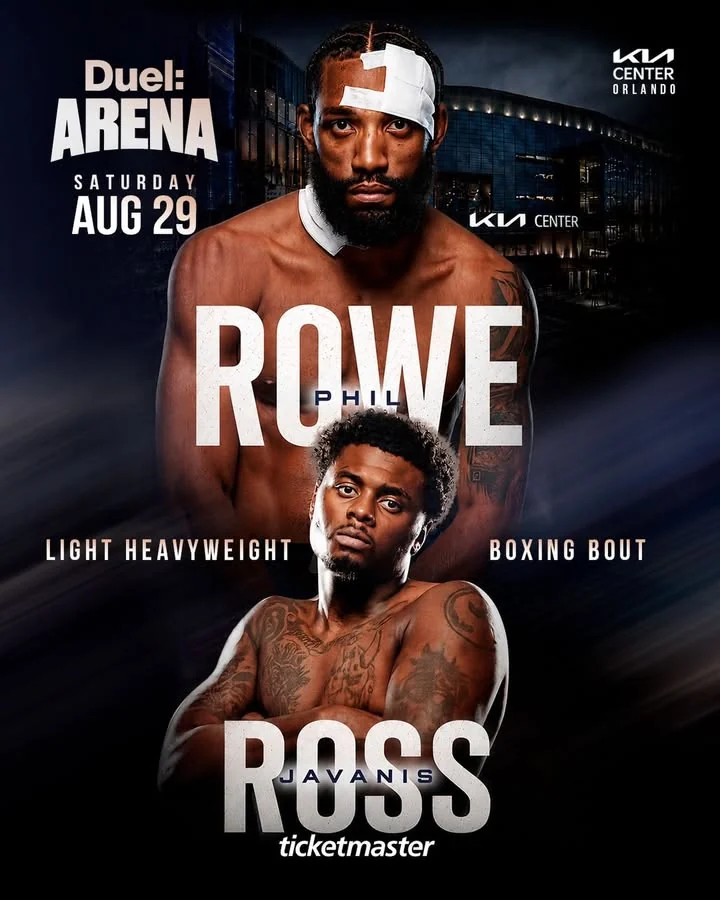
Professional boxing · 180.2 vs 181.0 lb · Saturday, August 29 · Kia Center, Orlando
Duel: Arena 1 · 29 AugustLight heavyweight · pro rules
Phil Rowe vs Javanis Ross at Duel: Arena 1
Two men who built their names knocking people out in a cage are going to try it with gloves on. Phil Rowe — five years a UFC welterweight, and an Orlando fighter in an Orlando arena — makes his professional boxing debut against Javanis Ross at 175 pounds. The promotion is selling it as a guaranteed firefight. The real records tell a more interesting story than the poster does, and we go through both below. For the rest of the card, start at our Duel: Arena 1 hub.
✅ FinalPhil Rowe beat Javanis Ross by unanimous decision after 4 rounds.
📌 Card is doneDuel: Arena 1 is over. The promotion has said from the start that it intends to run more — when Arena 2 is announced, we will cover it here.
⚖️ Weigh-in · Fri 28 AugPhil Rowe 180.2 lb (81.7 kg) · Javanis Ross 181.0 lb (82.1 kg). Both above the 175 lb the bout was billed at — so 175 was a billing figure, not a limit either man had to make.
Official full fight, published by Duel: Arena on YouTube. The player loads only when you press play.
Tale of the tape
Phil Rowe"The Fresh Prince"
vs
Javanis Ross"The Conqueror"
36
Age
31
6ft 3in 191 cm
Height
6ft 0in 183 cm
80in 203 cm
Reach
not listed
Orlando, FL
Fights out of
Starke, FL
12–7 7 KO, 5 sub
MMA record
9–5 7 KO
debut
Pro boxing
0–2 0 KO
UFC, 4–5
Top level
Regional / Gamebred
Green marks the fighter ahead on that line — note that on the only line about boxing, it's Ross, simply because he has actually had professional boxing matches. Ross's reach isn't published anywhere reliable, so we've left it blank rather than guess. MMA records vary by database: Tapology lists Ross at 6–4, combatreg at 9–5; we show the higher figure, which is the one the promotion is using.
About those knockout numbers
The announcement says Rowe has won 11 of his 12 career victories by knockout, and that Ross has won 8 of his 9 by knockout. Both figures are worth a second look before you build any expectations on them.
Public records list Rowe at 12–7 in MMA with seven knockouts — a genuinely high finishing rate, just not eleven. Ross is harder to pin down: Tapology has him at 6–4, combatreg at 9–5 with 7 knockouts. So the "9 wins" in the announcement is defensible; the "8 by knockout" is one too many. And in professional boxing — the ruleset this fight is actually contested under — his record is 0–2 with no knockouts, most recently a loss in October 2025.
To be clear: both fighters are real, the bout is real, and Rowe's finishing instinct is genuine. But promotional knockout counts are marketing copy, not a database. We'd rather give you the numbers you can verify than repeat a press release — check Tapology and BoxRec yourself if you want to see it first-hand.
Why does this matter beyond pedantry? Because if you're betting on the card, "both men finish nearly everyone" and "one man is a heavy-handed MMA fighter debuting in boxing against an opponent who is 0–2 as a pro boxer" are two very different propositions.
What happens when MMA fighters box
Neither man is a boxer by trade, and that shapes what this looks like. MMA strikers stand differently — wider, more square, weight further back, because they have to respect takedowns and kicks that don't exist here. Put them in gloves under boxing rules and the habits show up: hands drift low, the stance stays too open, and the four-ounce timing they've spent careers learning stops matching the ten-ounce reality.
Rowe has never had a professional boxing match. Ross has had two, and lost both. Whoever adapts faster in the first two rounds probably wins.
Rowe's advantage on paper is physical rather than technical: 6ft 3in with an 80-inch reach is a serious frame, and against an opponent moving up in weight, a long jab is the simplest way to win rounds without taking risks. Ross's case rests on the thing that doesn't show up in a boxing record — he's the one who has been landing genuinely spectacular knockouts recently, even if they came with kicks that are illegal here.
Both men came in above the advertised 175 lb
The promotion published Rowe at 180.2 lb and Ross at 181.0 lb on Friday. This bout has been billed throughout at light heavyweight, 175 lb — and neither man is near it.
That answers it. When both men come in five or six pounds over the advertised number, and the promotion posts both without comment, the number was never a limit anybody had to make — it was a label on a poster. Billed weights and contracted weights are frequently different, and this is one of those times. Nobody missed weight; the bout is simply heavier than advertised.
Who wins — and what the case is for each
No sportsbook had this priced when we wrote this, so treat what follows as reasoning rather than odds — Duel is the most likely place for this one to appear, being the promoter. On paper Rowe is the favourite, and the reasons are boring in the way real advantages usually are: three inches of height, a long reach he knows how to use, a decade against better opposition, and a career-long habit of finishing people. Against an opponent whose professional boxing career is two fights and two losses, that's a lot of arrows pointing one way.
The case for Rowe is everything on paper. The case for Ross is that boxing debuts are exactly where paper stops mattering.
Because here is the counterweight. Rowe has never had a professional boxing match. Not one. Everything he knows about hurting people, he learned in four-ounce gloves with kicks and takedowns in the mix. Ten-ounce gloves change what lands, three-minute rounds change the pace, and a man who can't shoot a takedown when things get uncomfortable has to solve problems a different way. Ross has been in that specific situation twice — and although he lost both, he has never been stopped in his career, amateur or professional.
So the honest read: Rowe should win, and probably early if his timing carries over. But the gap between "should" and "does" is widest in a debut, and a fighter who's hard to finish is the worst possible first opponent for someone learning a new ruleset in front of his home crowd.
How you called it
The poll is closed — this is how it stood when the bell rang.
Phil Rowe64%
Javanis Ross36%
66 votes cast before the fight
You called it. Phil Rowe won by unanimous decision.
Duel: Arena is run by Duel — the casino and sportsbook are the same operator.
Rowe fighting at the Kia Center is the closest thing this card has to a hometown story. He trains and lives in Orlando, and a debut promotion putting a local name on the undercard is not an accident — it sells tickets to people who'd otherwise skip a first-time show, and it gives the arena a crowd that reacts to something other than the main event's trash talk.
It also gives Rowe something to lose. A former UFC fighter debuting in boxing in front of his own city, against an opponent with two professional losses, is expected to win — and expected wins in front of a home crowd are the ones that hurt when they go wrong.
How the card was shown
Rowe vs Ross was on the Duel: Arena 1 undercard. Duel: Arena 1 ran on Saturday, 29 August at the Kia Center in Orlando — doors at 6:00 PM ET, first fight at 7:00 PM ET.
The card was pay-per-view at $29.99, ordered through DuelArena.tv and streamed worldwide via PlayLive. Fight week was free — the Thursday press conference and both Friday weigh-ins went out on the promotion's own YouTube and Facebook channels. The promotion has not said whether a replay will be sold or made free.
Full card and every result on the Duel: Arena 1 hub. If you came at this from a betting angle instead, our Duel sportsbook page covers the combat-sports markets and the licensing picture.
The rest of the card
Duel: Arena 1 was headlined by Mike Perry vs Brandon Jenkins under MMA rules, with Gypsy Crusader vs Ben Azoulay in heavyweight kickboxing. Adding professional boxing makes this genuinely the hybrid card the promotion promised — three rulesets in one night, all fought in a ring rather than a cage.
Matchmaker Dean Toole filled the rest of the card with former UFC fighters and influencer bouts. Our Duel: Arena 1 hub carries the full card, the venue and every result.
The bout was announced by @duelarena_. Fight records are from Tapology and BoxRec, not from the promotion's copy. Betting the card? Read the sportsbook page first, then Duel.com.
Things people actually ask
Who is Phil Rowe?
Phil Rowe, nicknamed The Fresh Prince, is a 36-year-old fighter based in Orlando who spent five years in the UFC's welterweight division, going 4-5 there with an overall MMA record of 12-7 including 7 knockouts. He stands 6ft 3in with an 80-inch reach and holds a BJJ black belt. Duel: Arena 1 is his professional boxing debut.
Who is Javanis Ross?
Javanis Ross, nicknamed The Conqueror, is a 31-year-old fighter from Starke, Florida. His MMA record is listed as 9-5 by combatreg and 6-4 by Tapology, including a spinning back kick knockout of Louis Brewington in March 2025. In professional boxing his record is 0-2, with his most recent bout in October 2025.
What are the rules for Rowe vs Ross?
It is a professional boxing match contested at light heavyweight, a 175 lb limit. Like every bout on the Duel: Arena 1 card it takes place in a ring. Both men come from mixed martial arts rather than boxing backgrounds.
Are the promotion's knockout numbers accurate?
They do not match public records. The promotion says Rowe has 11 of 12 wins by knockout; Tapology lists 12-7 with 7 knockouts. It says Ross has 8 of 9 wins by knockout; databases list him at 9-5 or 6-4 in MMA with 7 knockouts, and his professional boxing record is 0-2 with no knockouts. The fighters are real and the bout is real, but treat the promotional figures as marketing.
When was Phil Rowe vs Javanis Ross?
Saturday, August 29, 2026 at the Kia Center in Orlando, on the Duel: Arena 1 card. Doors opened at 6:00 PM ET and the first fight was at 7:00 PM ET. The running order was never published.