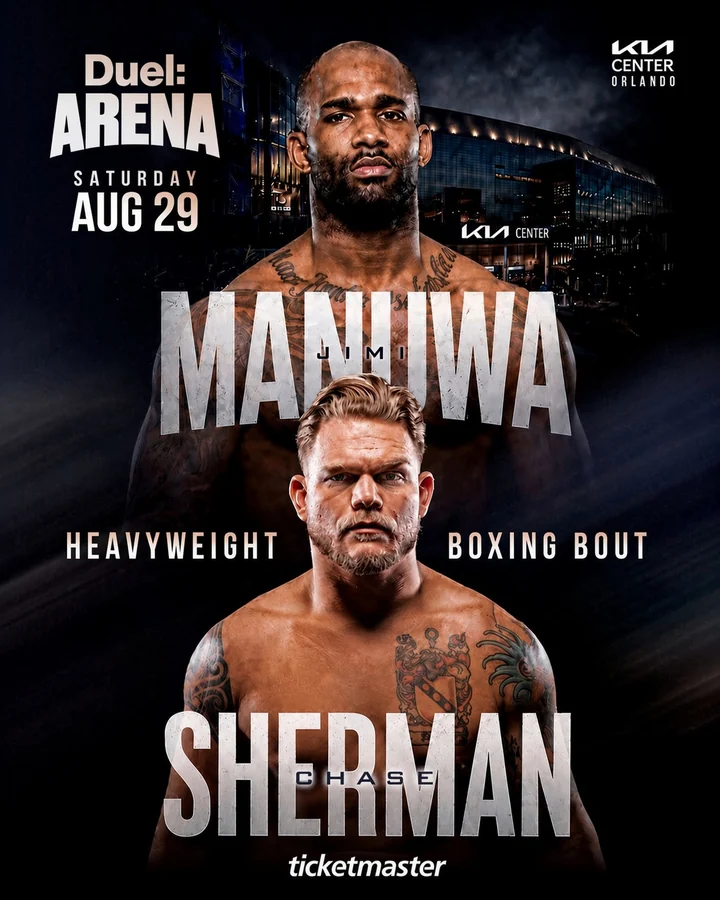
The opponent changed, and it changed the fight. Manuwa was booked against Rashad Coulter. He now gets the man who knocked Coulter out — Chase Sherman stopped him with an elbow in round two at UFC 211, in a fight that won Fight of the Night. Sherman is bigger, has boxed under gloves inside the last sixteen months, and competed as recently as April. Manuwa has not fought since 2019. For the rest of the card, start at our Duel: Arena 1 hub.
Green marks whoever is ahead on that line — and this is the part worth sitting with. Against Coulter, Manuwa had four inches of height, the longer frame and the better recent pedigree. Against Sherman he has none of it. The replacement did not just swap a name on the poster; it flipped almost every physical line on this table.
Jimi Manuwa's comeback was announced against Rashad Coulter, a 44-year-old former UFC heavyweight whose most recent outing ended with him being knocked out in a bare-knuckle title fight. It was, by any reading, a carefully chosen opponent for a man who had not competed in seven years.
That fight is off. The promotion has issued a fresh poster for the same date and the same slot with Chase Sherman opposite Manuwa, and no reason for the switch has been made public. The databases have not caught up yet — at the time of writing Tapology still lists the original booking. We keep the detail of the withdrawal, and what it means if you had tickets or a bet on it, on a separate page for the cancelled bout.
Sherman knocked Rashad Coulter out with an elbow in round two at UFC 211. That fight won Fight of the Night. Manuwa's replacement opponent is the man who beat his original one.
That single fact reframes the whole booking. This is not a like-for-like substitution — it is a harder night. Sherman is ten years younger than Manuwa, an inch taller, a natural heavyweight where Manuwa is a natural light heavyweight, and he has been in a professional fight this year.
Sherman is a heavyweight in the truest sense of the job description: 16-12 in MMA, with fifteen of his sixteen wins by knockout. That is a 94% finishing rate among his victories, and it is not padded — the man simply does not win decisions. He has exactly one on the record.
He spent two separate spells in the UFC between 2016 and 2023 and went 4-11 across them, which sounds worse than the role he was actually filling. Sherman was the division's stress test: the fighter matched against prospects and returning names, who took the fight on any notice and made it ugly. He beat Damian Grabowski, Ike Villanueva and Jared Vanderaa. He lost to Andrei Arlovski, Alexandr Romanov and Augusto Sakai. Everybody who beat him had to work.
Away from the cage he has been busier than most active fighters. He won the BKFC heavyweight title from Arnold Adams in 2019 and lost it to Joey Beltran the same year. Since 2023 he has competed in bare-knuckle MMA, gloved boxing, karate and a custom ruleset — four different disciplines, against Anthony Smith, Maurice Greene, Tim Johnson and Alex Nicholson among others.
The honest counterweight: those recent results are mostly losses. He is on a two-fight MMA skid, was submitted by Anthony Smith in the first round in April, and was stopped in fifteen seconds at Karate Combat in July 2025. He is durable, dangerous and thoroughly beaten-up, all at once.
Start with what boxing does to each man's weaknesses, because the ruleset is doing most of the work here.
Boxing removes exactly how Sherman has been losing. His two most recent MMA defeats were submissions — a rear-naked choke and a guillotine, both in bare-knuckle MMA. Six of his twelve career losses came by decision, two by submission. Under boxing rules nobody can take him down, choke him, or out-wrestle him for three rounds. What's left is the part he is genuinely good at: standing in front of a large man and throwing until something gives.
Boxing also suits Manuwa, and for the same structural reason — his MMA losses came against wrestlers and pressure fighters who took him down or walked him onto shots. Neither threat exists here. In his prime he was a devastating counter-puncher with a long, heavy straight right thrown from range, and that punch lives best under exactly these rules.
So both men get the ruleset they wanted. What separates them is time and size — and Manuwa loses both lines.
Seven years is not a layoff, it is a different life. Reflexes at 46 are not what they were at 39, and the last thing Manuwa's body registered in competition was being knocked unconscious in 42 seconds. Sherman fought in April. Whatever shape he is in, it is a known shape.
Then the weight. Manuwa built his career at light heavyweight — a 205 lb division. Sherman weighed 267 lb at his last weigh-in. In a heavyweight bout there is no limit to protect the smaller man, and ten-ounce gloves do not care how good your timing used to be if the man behind them last weighed in sixty pounds north of your career weight and is walking forward.
Honest read: Manuwa's best version wins this inside two rounds — he is the sharper puncher and the better athlete of the two at their peaks. But he has to find that version after seven years, at 46, against someone considerably larger who has been hit for a living all decade. If it goes past three rounds, the weight and the mileage start deciding it, and they decide it Sherman's way.
Neither man is a boxer by trade, and at this level that matters more than the promo suggests. MMA strikers carry their weight differently — stance wider and more square, because a narrow boxing stance invites a takedown. Under boxing rules that habit becomes a liability: it slows lateral movement and leaves you square to a hook you can no longer answer with a level change.
Glove size is the other quiet difference. Four-ounce MMA gloves reward timing and precision; ten-ounce boxing gloves absorb more, cover more of the face, and mean punches that used to end fights now only hurt. Fighters who built careers on one-shot finishing often find their knockout rate collapses in boxing, not because the power left, but because the arithmetic changed. Both of these men are one-shot finishers by trade — 88% and 94% of their wins respectively — so the padding cuts at both of them equally.
The one man with recent evidence is Sherman. He boxed Demarcus Kemp in May 2025 under gloves and won a unanimous decision — which tells you two things: he can make the adjustment, and he did not knock the man out. Manuwa has never done this at all. His boxing record on the night of August 29 will read 0-0.
Manuwa vs Sherman is on the Duel: Arena 1 undercard, so the same ticket covers it and the main event. The card starts at 6:00 PM ET on Saturday, August 29; the running order hasn't been published, so there's no confirmed time for this specific bout.
The broadcast is settled: pay-per-view at $29.99, ordered through DuelArena.tv and streamed worldwide via PlayLive. There is no television deal — the promotion sells it direct. Full detail on the Arena 1 hub.
Tickets start at $56.69 all-in for the back of the 100 level and run to $2,529.90 for ringside VIP, sold through the official Ticketmaster event page. Those prices include fees, which is not something every ticket site can say.
Planning to bet the card rather than attend? Our Duel sportsbook page lays out how combat sports markets work there, and the rakeback terms that apply to casino play but not to sports turnover — a distinction worth knowing before you deposit. One caution specific to this bout: a late opponent change is exactly the situation where early prices are least reliable, because they were set against a different man.
Fighters return for two reasons: money, or the ending they didn't get. Manuwa's exit was about as bad as endings come — knocked out in 42 seconds by Aleksandar Rakic, fourth loss in a row, retirement announced from the floor of a bad night. Seven years is long enough to stop caring about that, or long enough for it to become the only thing you think about.
As for why Duel: Arena — a debut promotion needs credibility, and a former UFC contender is credibility you can put on a poster. Both sides get something: the card gets a real name, and Manuwa gets a last fight that isn't the Rakic one. Whether a 46-year-old should be taking that fight against a 267 lb heavyweight is a fair question, and one worth holding in mind before you bet on it — including at Duel, where the card is priced by the promotion itself.
Two questions get answered on the night: whether a 46-year-old who has not competed since 2019 still has the hands, and whether Sherman's chin holds up under ten-ounce gloves. We post it here as soon as the bout is over rather than waiting for the full card to finish, and we say what actually happened — not what the promotion says happened. Results for every other bout land on the Arena 1 hub.
Duel: Arena 1 is headlined by Mike Perry vs Dillon Danis under MMA rules, with Gypsy Crusader vs Ben Azoulay in kickboxing and Phil Rowe vs Javanis Ross in boxing. Manuwa vs Sherman makes it two professional boxing bouts on a card that also stages MMA and kickboxing — three rulesets in one night, all in a ring.
There's a small piece of card symmetry worth flagging. Alex Nicholson, who fights Brad Taylor on this same bill, has faced Sherman twice: Nicholson knocked him out in the first round back in 2014, and Sherman returned the favour in bare-knuckle MMA in March 2024. They are 1-1, and both are in the building on August 29.
Newest addition to the card is Blake Anthony vs Nate Morrow at featherweight — an undefeated 7-0 prospect against a submission specialist, and the one bout here where both men are in their actual prime.